

When I first removed the pumping station, my finger stayed on the mouse for five seconds.
It is the third building I built with my own hands. The iron-gray support stands on the beach that has just faded from salt and alkali, and the roar of the water pump is the only artificial sound in this new wetland. A minute ago, it was still working hard to pump the salt water back to the sea and let the fresh water infiltrate the soil. Now, its task has been completed. The map shows that the ecological integrity of this area has reached 100%. A green prompt flashed gently: “Facilities can be recycled”.
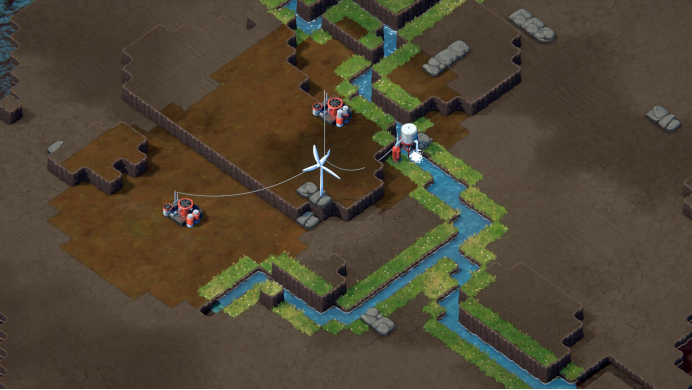
I clicked the removal button. There was no explosion or collapse. The pumping station seems to be weathered by the acceleration of time, turning into luminous green particles from the bottom, floating up and melting into the air. Ten seconds later, there was only a wet, glowing dirt and a egret that had just stopped. It tilted its head to look at the place where there was a building, and then strode away as if nothing had happened, as if there had always been only the sky and the swamp.
I was stunned at that moment. I have played countless construction games, and all I have learned is to expand, accumulate, and leave more magnificent monuments. And the first lesson Terra Nil taught me was: true healing begins when you learn to remove all the traces left by yourself.
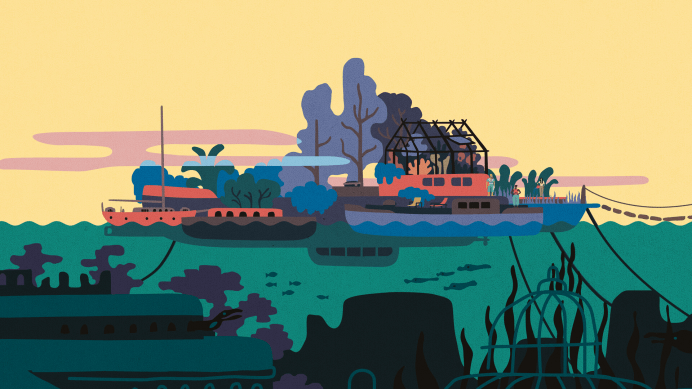
The game starts from a wilderness. Radiation-contaminated red soil, withered forest skeletons, and dry riverbeds. My tools are not axes and pickaxes, but “toxin scrubbers” that can purify soil, “atmospheric condensation towers” that can summon rain clouds, and “pollination drones” that can make bees return. I am no longer a pioneer. I am a careful doctor who is trying to awaken the pulse of a coma giant with the most sophisticated instruments.
The most wonderful thing is not to build, but to wait. After putting down the purifier, you need to wait. Looking at the red number slowly falling, watching the first touch of green spread on the land like blurred watercolor. Then, you need to observe the direction of the wind, calculate the direction of the river, and plant the first forest in the right place — not to obtain wood, but to give birds a place to nest. There is no resource column in the game, only an ecological network. Your every action is creating possibilities for the next life.
But the real challenge comes after prosperity. When an area changes from dead silence to vitality — frogs chirping in the wetland, deer crossing the regeneration forest, and fish shadows swimming in the river — the game will quietly remind you that it’s time to leave. Your wind turbines, your irrigation network, and your exquisite ecological buildings have completed their mission and have now become the abrupt ink dots on this natural picture.
The demolition process has an almost sacred sense of ritual. If you click on the building, it will not disappear directly. It will first enter the “hibernation” state and stop all sounds and operation. Then, as if the earth was gently absorbing it, the building began to dissipate into light dust from the edge. Finally, a small particularly lush grassland or a nest of newly appeared animals is often left in the original place. It seems to be saying naturally: Thank you. Now it’s up to me.
In the later stage of the game, what I faced was no longer pollution, but how to retreat gracefully. I need to plan the demolition order to ensure that the downstream ecology can be self-sustained before a water purification plant is removed; it is necessary to calculate the power supply so that the last drone can land quietly when the energy is exhausted after sowing. Clearing is not covered with medals, but watching the last artificial light point on the map go out, and then the satellite view is pulled away, showing a whole continent that is complete and colorful without any human mechanical outlines.
When I quit the game, I looked at the night view of the city outside the window. Neon lights, outlines of tall buildings, and windows that never go out. We are used to measuring value by “what is left behind”. But Terra Nil makes me think that perhaps the higher value lies in whether you have the courage to quietly erase all the evidence you have done after completing the mission.
It’s not like a game, but more like a meditation. About the limits of intervention, about the boundaries between help and control, about how we, as short-lived visitors, can gently touch a world that is much older and tougher than us. We always want to leave a mark, but perhaps the most profound healing is to learn to leave without leaving a trace, let the earth forget that someone had come, and only remember that we finally breathed completely again.