

At the beginning, I could only roll to the left.
My body — a perfect circle, but it lacks a crucial corner. That notch makes me lean to the left every time I roll, like a trolley that never adjusts the wrong direction. The world is a blank canvas, and only an invisible line guides me forward. When I rolled, the notch rubbed against the ground, making a subtle and incomplete rustling sound. That’s not music, but the noise of my existence.
Then I met a triangle.
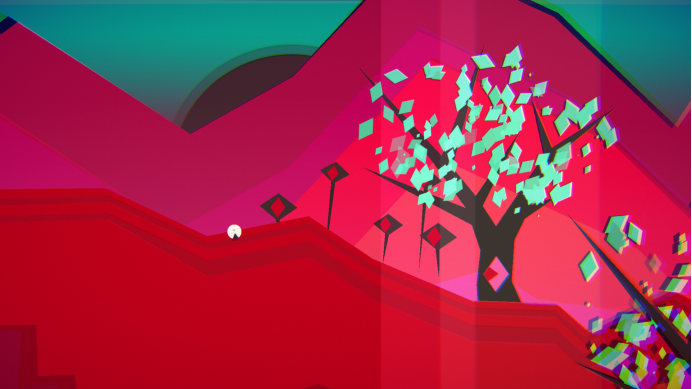
It stood quietly in the middle of the road, sharp and silent. I have no choice — my route is destined to pass through it. At the moment of collision, there was no spark or sound. The triangle disappeared, and I felt that my body was suddenly filled. A strange sense of hardness spread from the gap. I tried to scroll, and the world changed: I was no longer a clumsy circle, I had edges. Every rotation has a crisp “click” sound, like a precise bite of gears. I easily climbed a slope that I couldn’t reach before, because my new edges could catch the tiny protrusions on the ground. My essence has been completely changed because it accommodates others.
But this change comes at a price. On the flat road, the edges make me stumble and bounce, losing the smoothness. I miss the previous imperfect but continuous scrolling. Then, I fell into the sand. The edges became a burden, and I fell deeply into it. Just as I was almost still, the sand began to flow from my notch, and the outline of the triangle gradually blurred and loosened, and finally disappeared like scattered sand. I changed back to the incomplete circle and lay at the bottom of the sandbox. At the moment of loss, there is no pain, only a familiar and empty echo.
This is the loop of the game. When I met a square, it turned into a steady but slow square, which could press down the organ, but could not jump over the ravine. I encountered wave lines, and my body got a soft curve. I could slide through complex terrain like water, but I was weak when I needed strength. Each partner gave me a new way of perceiving the world, and also gave me a new limit. I’m not collecting ability, I’m experiencing a relationship that is destined to end. Their shape shapes my actions, and my journey is also shaping them irreversibly — wearing out their edges and consuming their characteristics until they can no longer fill my vacancy.
The loneliest moment happened between two “encounters”. When the previous shape had just dissipated and the next one had not yet appeared, I rolled on the road in the most primitive and incomplete form. At that time, the world seemed particularly empty, and the echo of the gap was particularly clear. I realized that my desire for “completeness” was so strong that I was willing to accept the filling of any shape, even if it made me strange, even if it would eventually leave.
The game didn’t tell me what the end point was. Maybe it’s a shape that can fill me perfectly, maybe it’s nothing. What pushes me forward is not the answer, but the kind of rolling inertia that cannot be stopped due to disability. I’m used to changing, learning new mobile languages when I have them, and revisiting the pain of old disabilities when I lose them.
When I finally came to the end of the journey, there was a calm lake in front of me, reflecting the sky. There is no final shape waiting for me. I stopped by the lake and looked at my reflection in the water — a circle with a gap. But in the gaze, I found that the water surface fluctuated slightly, and my reflection was also deformed with the waves, sometimes lengthened and sometimes flattened, as if it was simulating all the shapes I had experienced.
At that moment, I suddenly didn’t care so much about the gap. Perhaps the completeness does not lie in being filled, but in all the forms you have accommodated and experienced, which have been internalized into a memory and a possibility when you roll. My journey is not to find the missing corner, but to use this gap to decorate all the encounters and partings along the way.
I quit the game and looked at my spread palms. Isn’t each of us a circle with a gap? We fill ourselves with the “shapes” of love, friendship, career and ideals, and gain temporary balance and new abilities. We are bound to experience loss and change back to the clumsy, tilted and imperfect self.
Journey of the Broken Circle didn’t give me a fable about perfection. It gently tells me that we roll forward not to find the ultimate fill, but to experience those brief embraces that change our trajectory in the eternal absence. And the unique and incomplete rolling sound of life may be the truest proof of our existence.